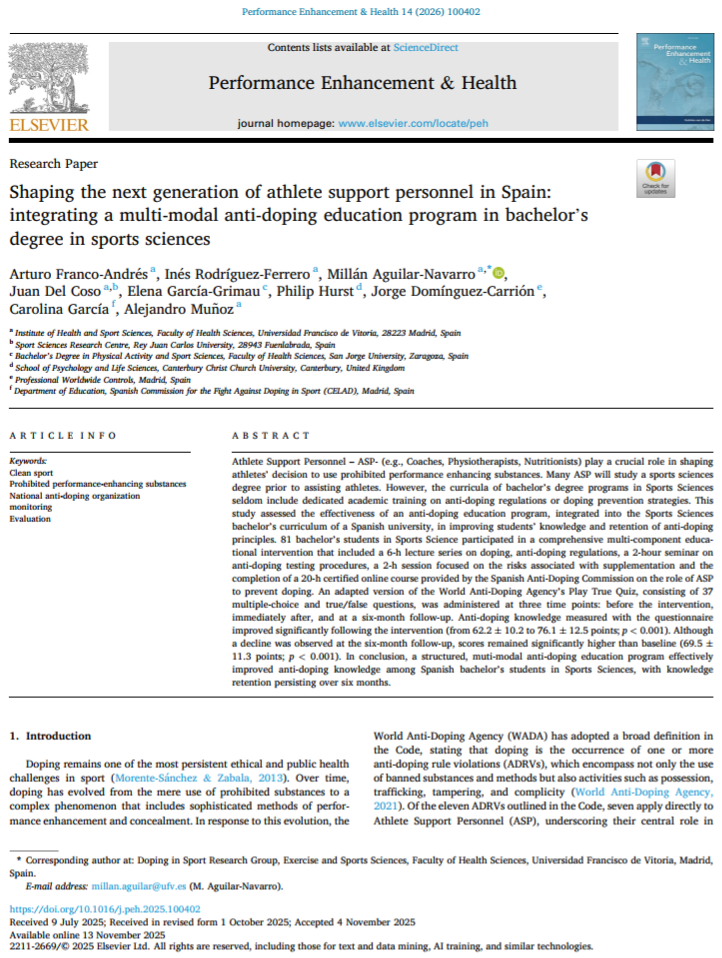
Shaping the Next Generation of Athlete Support Personnel in Spain: Integrating a Multi-Modal Anti-Doping Education Program in Bachelor’s Degree in Sports Sciences

Abstract

Athlete Support Personnel - ASP - (e.g., Coaches, Physiotherapists, Nutritionists) play a crucial role in shaping athletes' decision to use prohibited performance enhancing substances. Many ASP will study a sports sciences degree prior to assisting athletes. However, the curricula of bachelor's degree programs in Sports Sciences seldom include dedicated academic training on anti-doping regulations or doping prevention strategies. This study assessed the effectiveness of an anti-doping education program, integrated into the Sports Sciences bachelor's curriculum of a Spanish university, in improving students' knowledge and retention of anti-doping principles. 81 bachelor's students in Sports Science participated in a comprehensive multi-component educa- tional intervention that included a 6-h lecture series on doping, anti-doping regulations, a 2-hour seminar on anti-doping testing procedures, a 2-h session focused on the risks associated with supplementation and the completion of a 20-h certified online course provided by the Spanish Anti-Doping Commission on the role of ASP to prevent doping. An adapted version of the World Anti-Doping Agency's Play True Quiz, consisting of 37 multiple-choice and true/false questions, was administered at three time points: before the intervention, immediately after, and at a six-month follow-up. Anti-doping knowledge measured with the questionnaire improved significantly following the intervention (from 62.2 ± 10.2 to 76.1 ± 12.5 points; p < 0.001). Although a decline was observed at the six-month follow-up, scores remained significantly higher than baseline (69.5 ± 11.3 points; p < 0.001). In conclusion, a structured, muti-modal anti-doping education program effectively improved anti-doping knowledge among Spanish bachelor's students in Sports Sciences, with knowledge retention persisting over six months.

Methodology

Step 1
Sample selection

Undergraduate Sports Science students at a Spanish university were invited to participate.

Step 2
Baseline Knowledge Assessment

Administered an adapted WADA Play True Quiz to evaluate initial anti-doping knowledge.

Step 3
Multi-Modal Educational Intervention

Delivered a four-module program combining lectures, seminars, and a 20-hour certified online course.

Step 4
Immediate Post-Intervention Assessment

Re-administered the WADA Play True Quiz immediately after the intervention.

Step 5
Six-Month Follow-up Assessment

Re-administered the WADA Play True Quiz six months post-intervention to assess knowledge retention.

Step 6
Data Analysis

Utilized SPSS 27 for statistical analysis, including repeated-measures ANOVA and Pearson's correlation.

Key Findings

1.

A multi-modal anti-doping education program significantly improved anti-doping knowledge in Spanish Sports Sciences students.

2.

Knowledge retention persisted for over six months, with scores remaining significantly higher than baseline levels.

3.

The intervention effectively clarified ASP responsibilities, regulatory consequences, and institutional roles within the anti-doping framework.

4.

Students with stronger scientific foundations (higher physiology scores) demonstrated better anti-doping knowledge retention.

5.

Integrating structured anti-doping content into university curricula is an effective strategy to close existing knowledge gaps for future ASPs.

Visual Data

Knowledge on Athlete Responsibility

21% Pre-Intervention Success
63% Post-Intervention Success

Knowledge of athlete responsibility for prohibited substances increased from 21% to 63% post-intervention.

Anti-Doping Knowledge Evolution

Pre-Intervention 62.2 points
Post-Intervention 76.1 points
6-Month Follow-Up 69.5 points

Anti-doping knowledge scores significantly improved post-intervention and remained elevated at six months.

Top Improvements in Anti-Doping Knowledge by Question Topic (Pre- vs. Post-Intervention)

Athlete Responsibility (Possession) 42.00%
Athlete Sanctioning (Banned Personnel) 40.80%
Testing Procedures (Sample Storage) 39.50%

Key anti-doping concepts, such as athlete responsibility for prohibited substances and consequences of associating with banned personnel, saw the most significant knowledge gains after the education program.

Insights

Significant Knowledge Improvement

The program led to immediate and sustained increases in anti-doping knowledge among future Athlete Support Personnel (ASP), confirming its positive impact.

Sustained Knowledge Retention

Despite a slight decline at six months, knowledge scores remained significantly higher than baseline, indicating effective long-term retention.

Importance of Curriculum Integration

Integrating specific anti-doping content into university curricula proved effective in closing knowledge gaps identified in previous studies.

Role of Scientific Foundation

A correlation between physiology course scores and knowledge retention suggests that stronger scientific foundations aid in retaining anti-doping information.

Beyond Knowledge for Behavior Change

The partial knowledge decline at six months indicates that capability alone is insufficient; addressing motivation and opportunity is also crucial for actual behavior change, as per the COM-B model.

Conclusions

The multi-modal anti-doping education program significantly improved the knowledge of undergraduate Sports Science students, with partial retention of learning after six months. These results highlight the importance of integrating structured and continuous anti-doping education into university curricula, focusing on ASP. Additionally, it seeks to strengthen the competencies of future ASP, particularly coaches, to promote a culture of clean sport, and align academic programs with international standards set by the WADA.

Glossary

ASP (Athlete Support Personnel)

Professionals (e.g., coaches, physiotherapists, nutritionists) who have direct responsibilities toward athletes.

WADA (World Anti-Doping Agency)

The international independent agency responsible for promoting, coordinating, and monitoring the fight against doping in sport.

ADRV (Anti-Doping Rule Violation)

An infraction of anti-doping rules, encompassing use of banned substances, possession, trafficking, tampering, and complicity.

TUE (Therapeutic Use Exemption)

A waiver allowing an athlete to use a prohibited substance for a legitimate medical condition.

MOOC (Massive Open Online Course)

An online course aimed at unlimited participation and open access via the web.

COM-B Model

A framework in behavior change that identifies Capability, Opportunity, and Motivation as essential for any behavior to occur.

Q&A

What was the main goal of this anti-doping education program?

The program aimed to improve the anti-doping knowledge and retention among undergraduate Sports Science students in Spain, preparing them as future Athlete Support Personnel.

Did the knowledge gains last over time?

Yes, while there was a slight decline, students' anti-doping knowledge scores remained significantly higher than their baseline levels six months after the intervention.

Why is it important to educate Athlete Support Personnel (ASP) about anti-doping?

ASPs play a crucial role in influencing athletes' decisions regarding doping, and their knowledge is key to fostering clean sport behaviors and ensuring athlete welfare.

Research Impact

This research provides a robust framework for integrating anti-doping education into university sports science curricula, crucial for empowering future Athlete Support Personnel to champion clean sport and protect athlete welfare.