Exploring Anti-Doping Knowledge Level: a Systematic Review among Athletes, Students, and Athlete Support Personnel in the Sports Sector

Abstract

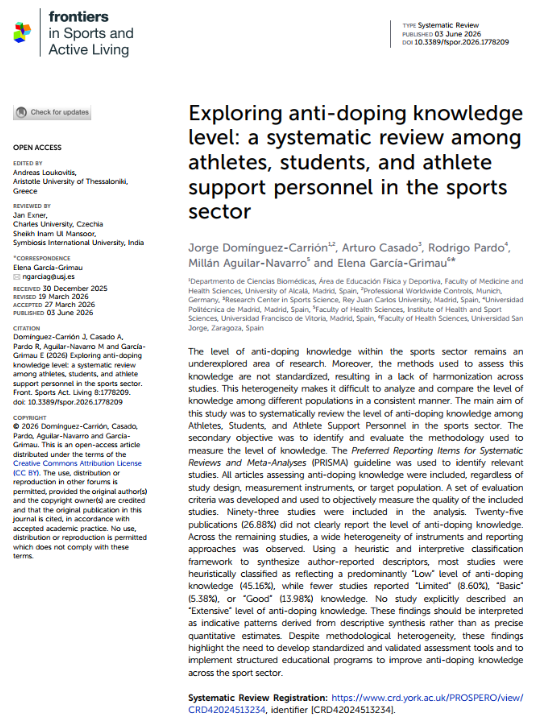
The level of anti-doping knowledge within the sports sector remains an underexplored area of research. Moreover, the methods used to assess this knowledge are not standardized, resulting in a lack of harmonization across studies. This heterogeneity makes it difficult to analyze and compare the level of knowledge among different populations in a consistent manner. The main aim of this study was to systematically review the level of anti-doping knowledge among Athletes, Students, and Athlete Support Personnel in the sports sector. The secondary objective was to identify and evaluate the methodology used to measure the level of knowledge. The Preferred Reporting Items for Systematic Reviews and Meta-Analyses (PRISMA) guideline was used to identify relevant studies. All articles assessing anti-doping knowledge were included, regardless of study design, measurement instruments, or target population. A set of evaluation criteria was developed and used to objectively measure the quality of the included studies. Ninety-three studies were included in the analysis. Twenty-five publications (26.88%) did not clearly report the level of anti-doping knowledge. Across the remaining studies, a wide heterogeneity of instruments and reporting approaches was observed. Using a heuristic and interpretive classification framework to synthesize author-reported descriptors, most studies were heuristically classified as reflecting a predominantly “Low” level of anti-doping knowledge (45.16%), while fewer studies reported “Limited” (8.60%), “Basic” (5.38%), or “Good” (13.98%) knowledge. No study explicitly described an “Extensive” level of anti-doping knowledge. These findings should be interpreted as indicative patterns derived from descriptive synthesis rather than as precise quantitative estimates. Despite methodological heterogeneity, these findings highlight the need to develop standardized and validated assessment tools and to implement structured educational programs to improve anti-doping knowledge across the sport sector.

Methodology

Step 1
Study Registration and Guideline Adherence

Registered with PROSPERO and designed in accordance with PRISMA systematic review recommendations.

Step 2
Search Strategy Execution

Searched PubMed, Scopus, SPORTDiscus, and Web of Science databases for records published up to December 2023.

Step 3
Screening and Selection

Screened 440 records to select 93 studies focusing on Athletes, Students, and Athlete Support Personnel.

Step 4
Quality Assessment

Evaluated methodological reporting quality using a custom checklist adapted from CONSORT and STROBE guidelines.

Step 5
Synthesis and Coding

Standardized highly heterogeneous qualitative descriptors into a five-point heuristic framework from 'Low' to 'Extensive'.

Key Findings

1.

An overwhelming majority of the classified studies (45.16%) reported a predominantly 'Low' level of anti-doping knowledge.

2.

Out of 93 studies analyzed, absolutely zero studies identified an 'Extensive' level of anti-doping knowledge in any target population.

3.

More than a quarter of the included studies (26.88%) completely failed to clearly report the level of anti-doping knowledge.

4.

A severe lack of standardization in assessment tools and methodology limits cross-study comparisons.

Visual Data

PRISMA 2020 flow diagram of the study selection process

440 Identification
272 Screening
71 Eligibility
93 Included

Despite a 572% increase in tests, AAFs emained stable and low, highlighting the deterrent effect of anti-doping measures.

Distribution of Reported Anti-Doping Knowledge Levels

Not clearly stated 26.88%
Low 45.16%
Limited 8.60%
Basic 5.38%
Good 13.98%
Extensive 0.00%

Heuristic classification of 93 systematic review studies shows a severe deficit in general anti-doping knowledge.

Insights

Widespread Knowledge Deficiency

A critical deficit in anti-doping rules and concepts exists across athletes, students, and support networks, which presents a systemic vulnerability under the WADC Strict Liability principle.

Methodological Chaos

The lack of standardized, validated diagnostic questionnaires makes it nearly impossible to consistently track or compare anti-doping literacy across different regions or sports.

Vulnerability of Support Personnel

Healthcare professionals like general practitioners and pharmacists show inadequate knowledge, introducing legal and health risks when advising athletes.

Integration into University Curricula

To elevate base-level knowledge, systematic anti-doping concepts must be integrated directly into physical education, sport science, and medicine degree programs.

Conclusions

This systematic review highlights a profound deficit in anti-doping knowledge across athletes, students, and athlete support personnel, coupled with massive inconsistency in how this knowledge is measured. Standardizing validated tools globally and executing structured educational campaigns is crucial to preventing inadvertent violations.

Glossary

Strict Liability

A legal and ethical rule in sports stating that athletes are solely responsible for any banned substances found in their biological samples, regardless of how the substance got there or their intent.

Infracciones de las Normas Anti-Dopaje (INADs)

A set of eleven specific infractions outlined by the World Anti-Doping Code, which go beyond the simple use of prohibited substances to include actions like evading testing, tampering, or possession.

Athlete Support Personnel (ASP)

Any individual, such as a coach, trainer, medical practitioner, manager, or parent, who assists, treats, or works directly with athletes preparing for or participating in sports competitions.

PRISMA Guideline

An evidence-based set of reporting standards designed to help researchers transparently and systematically document the methodology and findings of reviews and meta-analyses.

Código Mundial Anti-Dopaje (CMA)

The foundational document that establishes and harmonizes anti-doping regulations, policies, and rules across global sports organizations and public authorities.

Q&A

Why does low anti-doping knowledge pose a major risk to clean athletes?

Under the 'strict liability' rule, ignorance is not an excuse. An athlete who lacks anti-doping knowledge might unknowingly consume a banned substance or miss a whereabouts deadline, leading to immediate disqualification and professional bans.

Do coaches and doctors have sufficient anti-doping knowledge?

No, the review found that medical professionals and coaches often exhibit low to basic levels of knowledge, which creates serious liability risks when they advise athletes on medications or nutrition.

How can research and policy solve this issue?

Researchers must develop and globally validate a standardized questionnaire to isolate objective, factual anti-doping knowledge. Additionally, educational programs must become a mandatory part of university curricula in sports and medicine.

Research Impact

This research exposes a critical educational failure in global sports: baseline anti-doping knowledge is so low that athletes are structurally set up for accidental regulatory violations.
Exploring Anti-Doping Knowledge Level: a Systematic Review among Athletes, Students, and Athlete Support Personnel in the Sports Sector