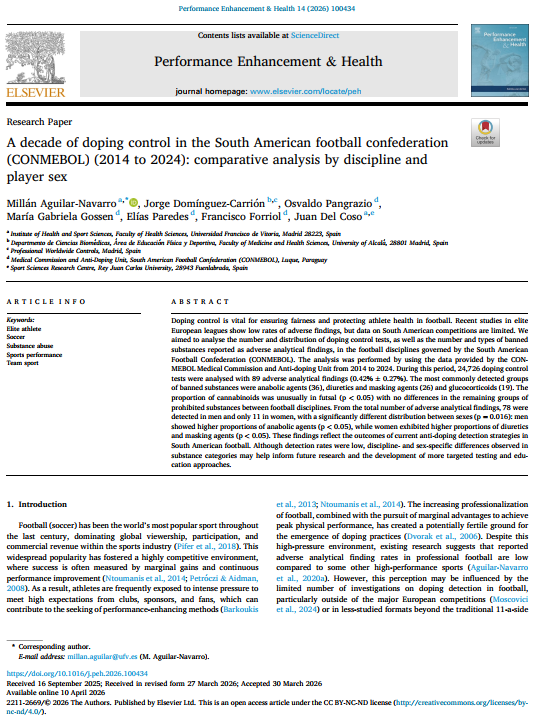
A Decade of Doping Control in the South American Football Confederation (CONMEBOL) (2014 to 2024): Comparative Analysis by Discipline and Player Sex

Abstract

Doping control is vital for ensuring fairness and protecting athlete health in football. Recent studies in elite European leagues show low rates of adverse findings, but data on South American competitions are limited. We aimed to analyse the number and distribution of doping control tests, as well as the number and types of banned substances reported as adverse analytical findings, in the football disciplines governed by the South American Football Confederation (CONMEBOL). The analysis was performed by using the data provided by the CONMEBOL Medical Commission and Anti-doping Unit from 2014 to 2024. During this period, 24,726 doping control tests were analysed with 89 adverse analytical findings (0.42% ± 0.27%). The most commonly detected groups of banned substances were anabolic agents (36), diuretics and masking agents (26) and glucocorticoids (19). The proportion of cannabinoids was unusually in futsal (p < 0.05) with no differences in the remaining groups of prohibited substances between football disciplines. From the total number of adverse analytical findings, 78 were detected in men and only 11 in women, with a significantly different distribution between sexes (p = 0.016): men showed higher proportions of anabolic agents (p < 0.05), while women exhibited higher proportions of diuretics and masking agents (p < 0.05). These findings reflect the outcomes of current anti-doping detection strategies in South American football. Although detection rates were low, discipline- and sex-specific differences observed in substance categories may help inform future research and the development of more targeted testing and education approaches.

Methodology

Step 1
Data Source Identification

Used annual reports from CONMEBOL Medical Commission and Anti-doping Unit (2014-2024).

Step 2
Data Extraction

Electronically extracted data from PDF reports into a spreadsheet by one author.

Step 3
Data Verification

A second author independently cross-checked all extracted data, resolving discrepancies by consensus.

Step 4
Rate Calculation

Computed annual percentages of adverse analytical findings and proportions per drug class.

Step 5
Statistical Analysis

Conducted crosstabs and Chi-square tests (SPSS v 27.0) to identify differences by discipline and sex, interpreting low-frequency results cautiously.

Key Findings

1.

A very low adverse analytical finding rate (0.42% ± 0.27%) was observed across 24,726 doping tests in CONMEBOL football from 2014 to 2024.

2.

Anabolic agents (36), diuretics/masking agents (26), and glucocorticoids (19) were the most commonly detected banned substances.

3.

Cannabinoid findings were disproportionately higher among futsal players compared to other football disciplines.

4.

Significant sex-based differences were found: men showed higher anabolic agent findings, while women exhibited higher diuretic/masking agent findings.

5.

Despite a 572% increase in doping controls from 2014 to 2024, the detection rate remained stable and low, suggesting a deterrence effect.

Visual Data

A Decade of Doping Controls in CONMEBOL (2014-2024)

24726 Total Tests
89 AAFs
0.42% AAF Rate
572% Test Increase (2014-2024)

Despite a 572% increase in tests, AAFs emained stable and low, highlighting the deterrent effect of anti-doping measures.

Adverse Analytical Findings by Player Sex

Men 78 findings
Women 11 findings

Men account for a significantly higher number of Adverse Analytical Findings compared to women.

Distribution of Most Commonly Detected Banned Substance Groups (2014-2024)

Anabolic Agents 36 findings
Diuretics & Masking Agents 26 findings
Glucocorticoids 19 findings
Stimulants 9 findings
Beta-2 Agonists 4 findings
Cannabinoids 3 findings

Anabolic agents were the most frequently detected, followed by diuretics/masking agents and glucocorticoids, across all football disciplines.

Insights

Low and stable detection rates persist despite increased testing

Despite a significant increase in anti-doping testing activities over the decade, the percentage of adverse analytical findings remained consistently low (below 1%), suggesting stable detection outcomes rather than an increase in doping prevalence.

In-competition testing yields most adverse findings

Most adverse analytical findings (95.6%) were detected in-competition, influenced by higher test volumes and substances specifically prohibited during competition, like glucocorticoids and stimulants.

Specific substance groups dominate adverse findings

Anabolic agents, glucocorticoids, and diuretics/masking agents were the most frequently detected substance groups, consistent with their known performance-enhancing effects.

Futsal shows higher cannabinoid detection

Futsal players exhibited a higher frequency of cannabinoid findings, likely due to recreational use rather than ergogenic benefits, highlighting cultural and regional influences on substance use.

Sex-specific patterns in substance detection

Male players had higher proportions of anabolic agents, typically linked to physical performance, while women had higher proportions of diuretics and masking agents, possibly related to weight control or body image pressures.

Conclusions

In summary, the analysis of CONMEBOL Medical Commission and Anti-Doping Unit reports from 2014 to 2024 reveals a consistently low detection rate of adverse analytical findings across football disciplines. Despite a significant increase in testing over the last decade, the percentage of positive findings remained stable at ~0.4%, reflecting stable detection outcomes under the existing testing framework rather than evidence of changes in doping prevalence. Given the low absolute number of adverse analytical findings, these results should be interpreted as descriptive and hypothesis-generating and may contribute to informing future anti-doping education and testing strategies when considered alongside complementary sources of evidence, such as athlete education data, behavioural research, and intelligence-led investigations.

Glossary

Adverse Analytical Finding (AAF)

The detection of a prohibited substance or its metabolites in an athlete's sample by a WADA-accredited laboratory.

Anabolic Agents

Substances that promote muscle growth and increase strength, often associated with performance enhancement in sports.

Diuretics and Masking Agents

Substances used to increase urine excretion or to conceal the presence of other prohibited substances in urine samples.

Glucocorticoids

Steroid hormones used to reduce inflammation and pain, often prescribed for managing injuries.

CONMEBOL

South American Football Confederation, the governing body of football in South America.

WADA

The World Anti-Doping Agency, an international independent organization responsible for anti-doping policies.

Q&A

How common is doping in South American football?

The study found a very low rate of adverse analytical findings, approximately 0.42%, indicating a stable detection outcome rather than high prevalence.

Do doping patterns differ between male and female football players?

Yes, male players showed higher proportions of anabolic agents, while female players had higher proportions of diuretics and masking agents, suggesting different motivations or concerns.

What are the most common types of banned substances found?

Anabolic agents, diuretics and masking agents, and glucocorticoids were the most frequently detected groups of banned substances.

Research Impact

This research provides crucial insights into doping patterns in South American football, informing the development of more targeted anti-doping strategies and educational programs tailored to different disciplines and player sexes.

A decade of doping control in the South American football confederation (CONMEBOL) (2014 to 2024): comparative analysis by discipline and player sex